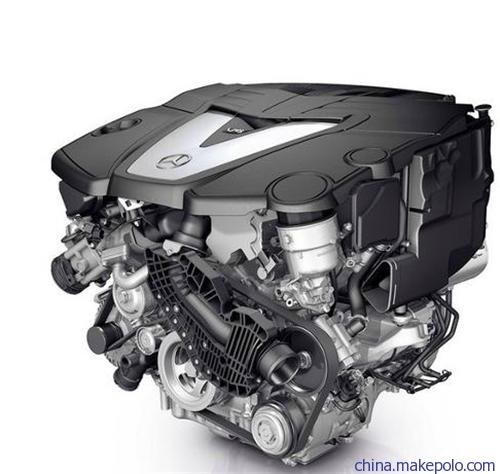
Automobile Engine
汽車發(fā)動機
Most automobile engines are internal combustion, reciprocating four-stroke gasoline engines, but other types have been used, including the diesel, the rotary the two-stroke, and super charged Reciprocating means up and down or back and forth. It is the up and down action of a piston in the cylinder block, or engine block that generates the power. The block is an iron or aluminum casting that contains engine cylinders and passages called water jackets for coolant circulation. The top of the block is covered with the cylinder head, which forms the combustion chamber. The bottom of the block is covered with an oil pan or oil sump. Power is produced by the linear motion of a piston in a cylinder. However, this linear motion must be changed into rotary motion to turn the wheels of cars. The piston is attached to the top of a connecting rod by a pin, called a piston pin or wrist pin. The bottom of the connecting rod is attached to the crankshaft. The connecting rod transmits the up-and-down motion of the piston to the crankshaft, which changes it into rotary motion. The connecting rod is mounted on the crankshaft with large bearings called rod bearings. Similar bearings, called main bearings, are used to mount the crankshaft in the block. The diameter of the cylinder is called the engine bore. Displacement and compression ratio are two frequently used engine specifications. Displacement indicates engine size, and compression ratio compares the total cylinder volume to compression chamber volume. The term stroke is used to describe the movement of the piston within the cylinder, as well as the distance of piston travel. Depending on the type of engine the operating cycle may require either two or four strokes to complete. The four-stroke engine is also called Otto cycle engine, in honor of the German engineer, Dr. Nikolaus Otto, who first applied the principle in 1876. In the four-stroke engine, four strokes of the piston in the cylinder are required to complete one full operating cycle. Each stroke is named after the action it performs intake, compression, power, and exhaust in that order
大多數(shù)汽車的發(fā)動機是內(nèi)燃機,往復(fù)四沖程汽油機��,但是也有使用其他類型的發(fā)動機���,包括柴油機�����,轉(zhuǎn)子發(fā)動機����,二沖程發(fā)動機和增壓發(fā)動機���。往復(fù)的意思就是上下運動或前后運動�,在往復(fù)式發(fā)動機中�,氣缸中活塞的上下運動產(chǎn)生發(fā)動機的動力�,發(fā)動機的缸體是鑄鐵或鑄鋁制造而成,構(gòu)成發(fā)動機的氣缸和冷卻液循環(huán)水套���。缸體的頂部是氣缸蓋��,由此形成燃燒室���,缸體底部是油底殼。氣缸中活塞的直線運動產(chǎn)生動力�,然而,必須將直線運動轉(zhuǎn)化成旋轉(zhuǎn)運動�,使汽車車輪轉(zhuǎn)動,活塞銷將活塞連接在連桿頂部��,連桿底部與曲軸連接����,活塞銷將活塞連桿頂部����、連桿底部與曲軸連接、連桿將活塞的往復(fù)運動傳遞給曲軸�,曲軸將其轉(zhuǎn)化為旋轉(zhuǎn)運動,連桿是用連桿曲軸安裝在曲軸上的���,用類似的軸承 即主軸承將曲軸固定在缸體內(nèi)。氣缸的直徑稱為發(fā)動機的內(nèi)徑���,排量和壓縮比 是兩個常用的發(fā)動機參數(shù)�����,排量指發(fā)動機的大小�,壓縮比是氣缸總?cè)莘e與燃燒 室壓縮容積之比���。沖程這一術(shù)語是用來說明活塞在氣缸內(nèi)的運動����,即活塞行程 的距離���。根據(jù)發(fā)動機類型�����,需要二沖程或四沖程來完成一個工作循環(huán)���。四沖程發(fā)動機也稱奧托循環(huán)發(fā)動機,這是為了紀念在1876年第一個應(yīng)用該原理的德國工程師奧托���。在四沖程發(fā)動機中�,氣缸活塞需四沖程來完成一個完整的工作循環(huán)�,每個沖程根據(jù)其行為命名分別為:進氣、壓縮��、作功和排氣四個沖程���。